
Two disasters, two different rescuers
Lu Yue is a practitioner from Nine Dragon Island in Investiture of the Gods. He later receives command of a group of plague deities, but the novel first introduces him as a dangerous opponent of the Zhou campaign. In chapter 58, his four disciples use supernatural afflictions against individual commanders. After Lu himself suffers a battlefield reverse, the attack expands into an epidemic throughout Xiqi. Civilians, King Wu and Jiang Ziya all become ill.
The few defenders still able to act face two problems: they must prevent an assault on the weakened city and find help for its inhabitants. Yang Jian uses a transformation to make the walls appear properly garrisoned, discouraging an immediate attack. The trick buys time; it does not cure anyone. After Yellow Dragon Perfected and Jade Tripod Perfected arrive, Yang travels to Fire Cloud Cave to appeal to the Three Sovereigns. He returns with miraculous medicine and the story of Shennong transmitting the herb chaihu.
Xiqi recovers. In chapter 59, Lu Yue discovers that his attack has failed and enters the city to fight again. His four disciples die in the confrontation, while he escapes wounded. This is not the end of his story: the surviving adversary later develops a different means of trapping Jiang Ziya.
At Cloud-Piercing Pass in chapter 80, Lu Yue and Chen Geng arrange twenty-one plague umbrellas into a formation. Jiang Ziya enters and becomes trapped beneath its supernatural force. His banner and the protection provided before the encounter keep him alive, but do not get him out. The eventual rescuer is Yang Ren, not Yang Jian. Sent by his teacher, Yang Ren uses the Five-Fire Fan to destroy the umbrellas.
Chapter 81 describes the deaths of Lu Yue and Chen Geng in the resulting fire. Li Ping enters the formation intending to persuade Lu Yue to stop opposing the Zhou army, but is mistakenly killed by Yang Ren's fan. The text records no conversation or response from Lu Yue: an intention to intervene is not evidence of repeated, rejected appeals. His later title, “Daoist Who Pacifies Plague,” gives this unrealized intention a tragic resonance.
These episodes should not be collapsed into a single outbreak. Xiqi concerns a sick city and Yang Jian's quest for aid; Cloud-Piercing Pass concerns a trapped commander and Yang Ren's destruction of the formation. Their separate histories converge in chapter 99, when Lu Yue, his four disciples, Chen Geng and Li Ping receive positions in the same divine group.
The four disciples: attacks, objects and a discrepancy in the directions
The crisis at Xiqi begins with four successive challenges, not with everyone in the city suddenly falling ill. Zhou Xin draws Jin Zha into pursuit and strikes his Headache Chime, leaving him in agony. Li Qi uses an Agitation Banner against Mu Zha, who shivers, burns with fever and collapses. Zhu Tianlin points his Dazing Sword at the airborne Lei Zhenzi, preventing him from keeping aloft. Yang Wenhui turns his Plague-Dispersing Whip against Longxuhu, who starts throwing stones into his own side's headquarters and has to be restrained. Chapter 58 connects each object to a particular attacker and victim.
The encounters disable abilities that normally make these heroes formidable. Pursuit, flight and stone-throwing cease to bring victory. The attackers need not remain superior in swordplay: they retreat and use a different kind of force against whoever follows. Jiang Ziya cannot explain what has happened or relieve the suffering. Four Zhou commanders are thus incapacitated before their opponents' master personally takes the field.
Lu Yue arrives with three eyes, a blue face, red hair and a golden-eyed camel. Surrounded in combat, he manifests three heads and six arms, displaying a seal, a plague bell, a fixing banner and a plague-stopping sword, among other objects. This does not make him invulnerable. Yang Jian strikes him with a pellet, Huang Tianhua wounds him with a dart and Jiang Ziya hits him with the God-Striking Whip. He escapes. The attack on the wider city follows this defeat; it is not evidence that every one of his powers has been unbeatable in single combat.
There is a genuine directional discrepancy within the cited transcription. Chapter 58 places Li Qi in the west and Zhu Tianlin in the south, both in the introductory descriptions and in the explanatory passage. Chapter 99 appoints Li Qi to the south and Zhu Tianlin to the west. Zhou Xin remains eastern and Yang Wenhui northern in both passages. An account of their introduction and an account of their final offices should preserve that difference instead of silently rewriting one passage to match the other.
This is one reason apparently conflicting rosters circulate. For the final appointments, chapter 99 answers the question. For the colours, directions and objects of the first encounters, chapter 58 is the relevant text. Establishing whether the discrepancy arose during composition, compilation or later transmission would require a comparison of editions; a single online transcription cannot decide that history.
Compare Investiture, chapter 58, the four challenges, with chapter 99, the plague appointments.
Four plague messengers and two further officials
Lu Yue's commission places six deities beneath him. Six excludes Lu himself. The list is also distinct from other traditions of “five plague gods,” whose names cannot simply be inserted into the novel.
Zhou Xin is the eastern plague messenger; Li Qi is the southern messenger.
Zhu Tianlin serves the west; Yang Wenhui serves the north.
Chen Geng, who helped Lu Yue prepare the plague formation. His later title does not mean that moral exhortation was his role throughout his life.
Li Ping intends to intervene with Lu Yue but is mistakenly killed on entering the formation; no attempt at persuasion is recorded.
Threat, moral exhortation and pacification coexist in this group. Yet a few official titles do not establish a detailed celestial hospital, pharmacy or disease-approval procedure. The novel supplies names, histories and commissions. Any elaborate administrative machinery beyond them would require its own textual evidence.
What changes outside the novel
The pox deities have another story at Tong Pass. Yu De spreads poisonous pox, and Yang Jian makes a further journey to Fire Cloud Cave. Yu Hualong's five sons then receive the five directional pox appointments. They are not Lu Yue's four directional messengers, even though both episodes draw on the fear of epidemic disaster.
Living ritual traditions are not simply performances of the novel. UNESCO's account of the Ong Chun, or Wangchuan, ceremony describes communities in coastal Fujian and Melaka, Malaysia, honouring Ong Yah and remembering people lost at sea. Welcoming the deity, processing with a boat and aiding wandering souls connect disaster protection with maritime memory and community life. Calling the participants “Lu Yue's subordinates” would erase the particular history and purpose of this practice.
The novel's medicines and supernatural weapons are literary devices, not evidence for diagnosing or treating actual infections. Nor should the language of divine punishment be used to blame a patient: the inhabitants of Xiqi and the story's sympathetic leaders suffer too. These tales are more revealing as accounts of overwhelming danger, appeals for help and the effort to restore collective life.
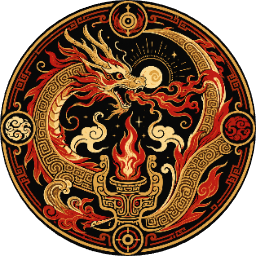
The cover is a modern thematic illustration, not an ancient ritual diagram, a medical record or an image for identifying symptoms.
Texts and a living tradition
- Investiture of the Gods, chapter 58, and chapter 59: the outbreak at Xiqi, the quest for medicine and the disciples' deaths.
- Chapter 80 and chapter 81: Li Ping's intervention and Yang Ren's defeat of the plague formation.
- Chapter 99: Lu Yue and the six appointments.
- UNESCO: Ong Chun/Wangchuan/Wangkang ceremony: ritual, maritime memory and community connections.