
The outbreak at Tong Pass
In chapter 81 of Investiture of the Gods, the Zhou army reaches Tong Pass, where Yu Hualong commands the garrison with four of his sons. A fifth son, Yu De, has been studying overseas. After Yang Jian's hound wounds Yu Hualong and Nezha injures Yu Xian, Yu De comes home and treats his father and brother. He then challenges the Zhou commanders, but is surrounded and forced to retreat. His decision to spread pox follows this defeat.
That night, Yu De directs his four brothers in a magical attack. They rise above the Zhou camp on clouds of the five directions and scatter poisonous pox. Soldiers and commanders develop fever, pain and eruptions; cooking fires disappear as the army becomes unable to function. King Wu and Jiang Ziya fall gravely ill. Nezha escapes the affliction because of his lotus body, while Yang Jian has anticipated danger and spent the night outside the camp. These are the novel's explanations for their survival, not claims about actual immunity or disease prevention.
Yu Da proposes attacking the helpless camp, but Yu De insists that the illness will finish the army without further fighting. This delay gives the Zhou side time to seek help. Yellow Dragon Perfected and Jade Tripod Perfected arrive and send Yang Jian to Fire Cloud Cave with a letter. Fuxi consults Shennong, and Yang receives three miraculous pills for the king, Jiang Ziya and the rest of the army.
Yang Jian asks more than how to rescue his companions. He also wants to know the name of the illness and what future sufferers should do. This leads into the tale of Shennong transmitting the herb shengma. Yang returns with the remedy, and he and Nezha help restore the camp. The survivors' facial scars remain a visible reminder of the disaster. The episode combines a military crisis with a story about the origins of healing knowledge.
Chapter 82 completes the conflict. Seeing that the Zhou army has recovered, the Yu family finally attacks. All five sons die in the battle, Tong Pass falls, and Yu Hualong takes his own life. Jiang Ziya orders an honourable burial for the family. Only much later, in chapter 99, do these dead adversaries receive their appointments as pox deities.
This is not a story in which illness proves the victims' wickedness. The afflicted include the king whom the narrator supports, Jiang Ziya and ordinary soldiers. Reducing the outbreak to punishment for a patient's moral failings misses the events of the novel and wrongly transfers responsibility for disease onto sufferers.
The last battle at Tongguan: the five sons and the army's recovery
At the opening of chapter 82, the Yu family climbs the walls on the eighth day and discovers that the Zhou camp has regained its energy and discipline. Yu Da reproaches Yu De for preventing an earlier attack. Yu De realizes that someone must have defeated his magic, but argues that recently sick opponents will still be too weak to fight effectively. The family makes two successive misjudgments: first waiting confidently for everyone to die, then confusing recovery with an inability to resist.
In the ensuing battle, Nezha manifests three heads and eight arms and takes his wind-and-fire wheels onto the walls of Tongguan. The defenders scatter. Surrounded by Zhou fighters, the Yu family cannot disengage to save the pass. Lei Zhenzi strikes Yu Guang; Yu Da attacks in revenge and is killed by Wei Hu's demon-subduing pestle. Yang Ren's fan kills Yu Xian and Yu Zhao. After seeing all four brothers fall, Yu De attacks Jiang Ziya, is knocked down by the God-Striking Whip and is killed by Li Jing. Neither Nezha nor Yang Jian single-handedly kills all five future directional pox gods.
Jiang Ziya is not depicted as completely unaffected by the illness. The text says that he has only just recovered and doubts his ability to fight, which is why he urgently uses the whip. After Tongguan falls, soldiers who have not recovered remain there for care. The generals are still weak, and King Wu rests at the pass while preparations begin for the Ten Thousand Immortals Formation. The miraculous rescue ends the immediate emergency without erasing every consequence from the narrative.
After Yu Hualong takes his own life, Jiang Ziya issues orders to reassure the population, inventories the stores and has the dead family buried honourably. The novel thus depicts deliberate harm while also mourning loyalty to the Shang ruler. These judgments coexist. The later appointment cannot be reduced to the claim that every recipient was already an uncomplicated protector: an enemy can be condemned for an action and respected for a particular form of loyalty.
Lady Jin is explicitly identified in the appointment passage as Yu Hualong's wife and given the title of Holy Mother Who Guards the Chamber. The cited Tongguan episodes do not separately narrate a campaign in which she dispenses medicine, rescues infants or fights alongside the family. Her inclusion in the household's disease-related divine appointments is supported; a fully developed biography assembled from such imagined episodes is not.
Details: Investiture, chapter 82, from the opening battle to the rest at Tongguan. Lady Jin is appointed in chapter 99.
The five directions and the household appointment
Chapter 99 appoints Yu Hualong as the Pox-Ruling Bixia Yuanjun, placing the five directional pox gods under him. His commission uses traditional ideas about seasonal illnesses, long and short lives, and the balance or disruption of yin and yang. The same passage names his first wife, Lady Jin, as the Holy Mother Who Guards the Chamber. She belongs in an account of the family's appointments, although she is not one of the five directional gods.
Yu Hualong, the commander of Tong Pass and father of the five sons.
Yu Da governs the east; Yu Zhao governs the west.
Yu Guang governs the south; Yu Xian governs the north.
Yu De, the fifth son and architect of the magical outbreak, governs the centre.
Lady Jin, Yu Hualong's wife, receives a separate title in the same commission.
The five directions are east, west, south, north and centre. They are neither five modern administrative regions nor five medically defined diseases. The earlier five-colour imagery and the final directional appointments connect the family's powers with those five directions. That structure helps explain the pantheon, but it is not a diagnostic system.
Pox gods, plague gods and the Mount Tai goddess
The Plague Bureau centres on Lu Yue, four directional plague messengers and two further officials associated with moral exhortation and the pacification of plague. Yu Hualong's family has its own story and a separate commission. The two groups share the novel's concern with epidemic catastrophe, but they are not interchangeable lists. Chapter 81 even has Nezha and Yang Jian recall the earlier disaster caused by Lu Yue.
The title Bixia Yuanjun also needs context. Mount Tai heritage records describe a goddess affectionately known as the Grandmother or Holy Mother of Mount Tai. In the novel's pox commission, however, the recipient is Yu Hualong, a male military commander with a wife and sons. A shared divine title does not, by itself, establish a single biography. The novel and the local temple tradition must be compared before identities or family relationships are combined.
Reading a healing legend as a legend
The poisonous pox, immortal pills and transmission of shengma are literary episodes, not validated treatments. The World Health Organization records the global eradication of smallpox in 1980. Historical descriptions of eruptions should not all be retrospectively diagnosed as smallpox either. The cave visit matters here because it connects divine danger with rescue and the transmission of knowledge; it does not supply a prescription, dosage or ritual substitute for medical care.
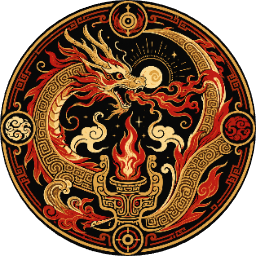
The cover is a modern illustration inspired by the five-directional pox deities. It is neither an ancient medical chart nor a documented reconstruction of historical cult images.
Texts and reference material
- Investiture of the Gods, chapter 81: the outbreak, Yang Jian's cave visit and the shengma legend.
- Chapter 82: the family's final battle and burial.
- Chapter 99: the five directional appointments and Lady Jin's title.
- Tai'an culture and tourism authority: Dai Temple heritage: Bixia Yuanjun as the local Mount Tai goddess.
- World Health Organization: Smallpox: modern public-health context, separate from the fictional cure.